
Local communities across South Africa are paying the price with their health while big tobacco corporations continue to grow their profits, according to the National Council Against Smoking (NCAS).
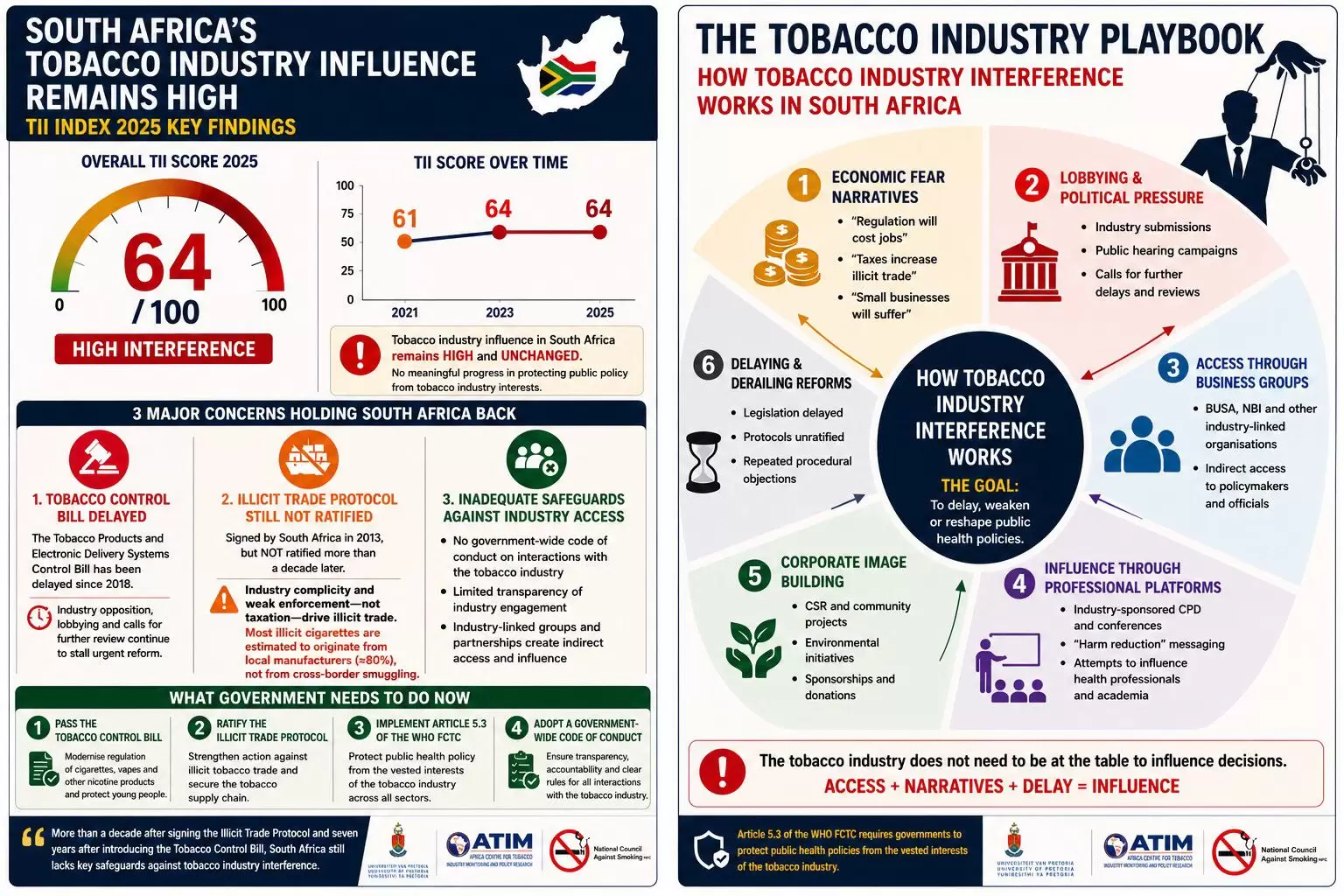
The 2025 South Africa Tobacco Industry Interference (TII) Index, launched yesterday, revealed that South Africa ranks 56th out of 100 countries globally for protecting public health policies from tobacco industry interference. The report, published by the NCAS and the Africa Centre for Tobacco Industry Monitoring and Policy Research (ATIM), found that South Africa has made no progress in reducing tobacco industry influence, maintaining a high interference score of 64 since 2023.
For vulnerable communities, this regulatory standstill has serious consequences. The report noted that tobacco-related illnesses claimed more than 32 400 lives in South Africa in 2025 alone.
The NCAS said the continued delay in passing the Tobacco Products and Electronic Delivery Systems Control Bill represents one of the industry’s biggest victories and a major setback for public health.
Professor Lekan Ayo-Yusuf, Executive Director of the NCAS, said the tobacco industry uses corporate social responsibility initiatives to improve its public image despite overwhelming evidence linking tobacco use to cancer and other deadly diseases. He said because global studies have long established the harmful effects of tobacco, companies use community projects and charitable initiatives to portray themselves as responsible corporate citizens.
“If the industry truly cared about the health or development of the people, they would not be increasing their marketing to young people,” Ayo-Yusuf said. He added that initiatives such as funding school renovations or providing water infrastructure are often aimed at securing political goodwill and discouraging the implementation of regulations that could reduce tobacco consumption.
The delay in passing the legislation allows the multi-billion-rand tobacco and vaping industry to continue targeting young people while placing additional pressure on healthcare facilities treating patients with chronic illnesses. Thato Mmako, Tshwane Chairperson of the South African Tobacco Free Youth Forum (SATFYF), strongly criticised the political deadlock surrounding the bill.
He said a government influenced by the tobacco industry would struggle to regulate it effectively. “The system requires sober-minded individuals who will not be bought out by the industry,” Mmako said. He added that it was difficult to understand why lawmakers would oppose legislation designed to regulate products known to cause serious health problems.
“How do you refuse legislation that regulates a poison that is killing your nation, and still claim to be a patriot or pro-human?” he said. He added that it was unacceptable for leaders to place corporate interests ahead of the wellbeing of ordinary citizens.
The report emphasised that reducing tobacco-related deaths is no longer primarily a technical challenge, but a political one that requires accountability and decisive action. Vimla Moodley, author of the South African TII Index, warned that stability in the country’s interference score should not be mistaken for progress. “The concern is that South Africa is unable to reduce tobacco industry interference after five index reports and recommendations. The country remains trapped in a cycle of recurring vulnerabilities,” she said.
Moodley said the tobacco industry does not need to defeat health legislation outright; delaying its implementation is often enough to create regulatory uncertainty and weaken public health protections. She added that tobacco industry interference extends beyond the health sector and requires a coordinated government response. “Health departments alone cannot manage tobacco industry interference; it requires an urgent, whole-of-government response,” she said.
