Authors: Matlhodi Matsei and Nomazulu Moyo
Inflation moderated in July. But for South Africa’s middle class, that is not the same as relief. The middle class is often spoken about as if it has enough financial room to absorb rising costs. Increasingly, the numbers tell a different story.The Competition Commission’s recent Cost of Living Report rightly highlights the structural increases in essentials like electricity, water, education, and healthcare. Our data at Professionals and Business for Change (PBC) confirms this: for middle-income households, these costs are not just high, they are relentless.At PBC, we track these pressures through our Cost of Living Dashboard and South Africa’s Middle-Income Inflation Monitor. While some pressures eased in July, the underlying squeeze on middle-class budgets remains.
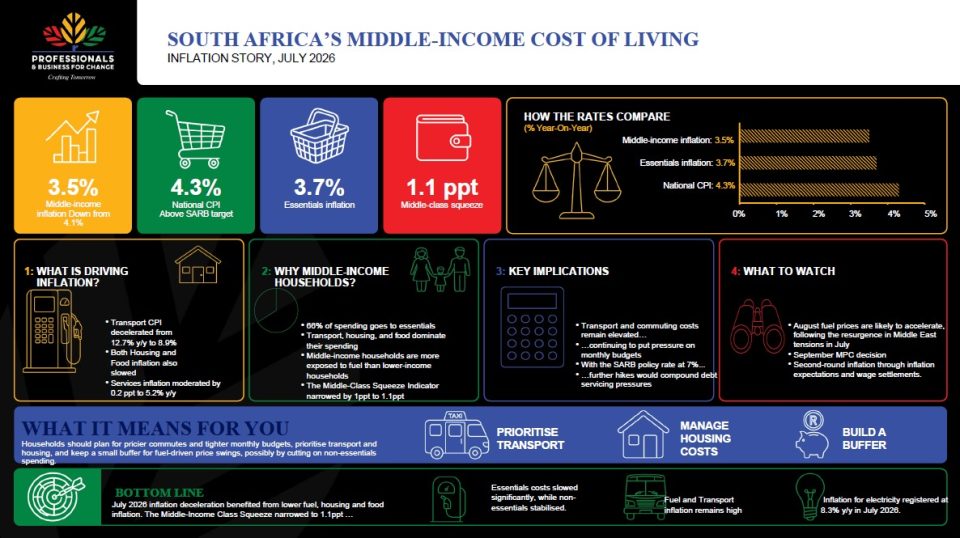
In June 2026, the PBC Middle-Income Inflation Indicator moved above 4% year-on-year for the first time in nearly two years. National headline inflation reached 5%, with transport inflation a major driver. By July, inflation had moderated: middle-income inflation eased to 3.5%, while national CPI stood at 4.3%. Essentials inflation for the middle class registered at 3.7%, and the Middle-Class Squeeze Indicator narrowed by one percentage point to 1.1 percentage points.This is encouraging, but it does not mean middle-income households have more money in their pockets. Yes, the lower inflation rate means prices are rising more slowly, but it does not mean that price levels have gone back down.For many families, that distinction is the difference between managing and falling behind.
Transport inflation slowed from 12.7% year-on-year to 8.9% in July, still a significant increase. In addition, electricity inflation stood at an elevated 8.3%. For middle-income households who spend about 66% of their budget on essential goods and services, including transport, housing and food, this remains a heavy burden.When most of a household’s income is already committed to necessities, there is little room to manoeuver when other bills rise.
The middle class is caught in the middle
This is what makes the position of middle-income households particularly difficult. Many earn too much to qualify for meaningful social support, but they do not necessarily have the savings, investments or other financial buffers available to wealthier households. They are therefore exposed to rising costs without having many places to turn.Transport is a good example. For South Africans who can afford it, getting to work means paying for fuel, vehicle finance, insurance and maintenance. Others rely on public transport, which includes taxis, buses or a combination of different forms of transport.The cost does not end with the trip to work. Higher transport costs also feed into household budgets more broadly, through the cost of moving goods and providing services.
There is a risk that the fuel price relief could prove temporary, as the global oil market and prices remain vulnerable to volatile geopolitical developments. A sustainable increase in oil prices, resulting from renewed tensions in the Middle East can ultimately feed into South Africa’s fuel prices. And for households already struggling to balance their budgets, another fuel price shock would have consequences well beyond petrol pump prices.For businesses, higher transport and operating costs can influence pricing decisions. Workers may also seek higher wages to compensate for increased living costs. Inflation expectations can also become more difficult to contain.
These are the second-round effects that policymakers keep a close watch on. And indeed, the South African Reserve Bank’s Monetary Policy Committee faces a difficult balancing act in its upcoming briefing on 23 September 2026, against the current backdrop.The policy rate is currently at 7%, and the question is not merely whether headline inflation is above the Bank’s 3%±1% target. Policymakers also have to consider whether second-round effects have broadened sufficiently to justify further hikes.Further increase in interest rates would have direct consequences for household debt-servicing costs towards mortgages, vehicle finance and other forms of credit. This will intensify the financial strain for the middle class, putting further added pressure on their disposable income.
The squeeze is bigger than fuel
Beyond transport and debt-servicing costs, the cost-of-living problem is also largely structural in nature. Essential and administered costs including electricity, water, education and healthcare have all risen substantially over the years. These costs are indispensable to households. And unlike discretionary spending, they do not respond quickly to interest rates changes.This creates another problem that deserves greater attention: what we describe as the double payment trap. South African households pay taxes for public services that fail them, and then pay again for private alternatives. Private security, medical aid, backup power, private schooling. This is the double payment trap. It is a direct transfer of wealth from household budgets to compensate for state failure.The result: households pay twice: once through taxes, and again directly.For a middle-income family, that burden can be significant.
The policy conversation must go beyond interest rates
Interest rates are an important part of the inflation debate, but they cannot resolve all the cost of living challenges facing South African households. If electricity, healthcare, education, transport and other essential costs continue rising faster than household incomes, simply adjusting the interest rate will not address the underlying problem.South Africa also needs structural reforms aimed at reducing the cost of living and doing business. That includes improving the reliability of public services, creating conditions for higher employment rates, stronger income growth, addressing the costs built into transport and energy, and reducing the need for households and businesses to pay privately for services that are already funded through taxes.
The goal should be to create an economy in which households have enough financial room to save, invest, pay down debt and participate meaningfully in economic growth.This is particularly important for the middle-income professional class, which plays a significant role in the economy but is often overlooked in debates about affordability. To properly understand the middle class, we need to know which costs are important for this cohort, and what their key drivers are. We also need to understand how these costs are changing and their impact on household finances.
We need to look beyond headline inflation
This is why measuring the cost of living matters.National headline inflation provides an important picture of what is happening across the economy, but it does not necessarily tell us what different income groups are experiencing. The spending patterns of a middle-income household are different from those of a lower-income or wealthier household.This is what we are advocating for at PBC, and why developed the Cost of Living Dashboard, which is accompanied by South Africa’s Middle-Income Inflation Monitor, for Deciles 4-7.Our indicators are updated every month alongside the Stats SA CPI releases. They allow us to look more closely at the pressures facing middle-income households and to understand which goods and services are putting the greatest strain on their budgets.
The July data provides a good example of why this matters: On paper, inflation moderated, with middle-income inflation cooling, and the Middle-Class Squeeze Indicator narrowing meaningfully. Nevertheless, transport and electricity inflation remained elevated during this period. So, while the overall picture improved, the pressure on household budgets persisted.That is an important distinction.About Professionals and Business for Change: PBC is a collective of professionals and business owners working to capacitate the state, activate the middle-income professional class, and forge public-private partnerships that deliver tangible results for all South Africans.